Radiant not keeping up

Hi,
This may get lengthy and cause more questions than answers…thank you for your patience ahead of time.
We have been living offgrid full time for over a year. Primary heating is wood with radiant staple up as backup or shoulder seasons. We are in the northeast corner of VT.
Rinnai boiler, 3 heat zones, 1 hot water tank zone.
We finished our master bedroom/bathroom after we moved in. I had a plumber do the work for plumbing and adding the 3rd zone for radiant floor staple up pex. I assumed he knew what he was doing.
The entire room is 20x20. 9 foot tall ceiling. sliding door to deck. 2 windows that are 3'x4.5'. bathroom window is 1.5'x2'. 2x6 walls with r21 fiberglass insulation with pine t&g. ceiling is sheetrock with 18 inches of blown in on top of r13 fiberglass insulation. This sits on a 4 foot crawlspace and all the bays have 2.5 inches of rigid foam board in the bays and then a thin layer of sprayfoam in all the bays to seal it.
The radiant is 2 - 3/4 inch runs from the boiler. it's about 40 feet long to the bedroom. The feed and return lines go into manifolds in the crawlspace. From the manifolds, there are 3/8 inch lines going into the bays, all run in aluminum plates for the pex.
When it's 5 degrees out, this room maxes at around 60 degrees. I leave the bedroom door closed because the heat from the wood stove doesnt make it into the room to well.
I have done so many things to settings to remedy this…and I'm DIY'ing it because I cant get anyone up in this area to show up, never mind having the expertise.
Currently, I have the Rinnai set at 165 degrees, I disconnected the outdoor reset, I have checked the temps on the feed and return pipes, I have the grundfos off grid friendly circulators. I have to put it on max to get 2 gallons a minute. Any other settings give me 1 or less than 1. I also adjusted the manifold to let the max flow through. At least I think I adjusted to do that. I have a FLIR gun, so I can get temp readings on the floors if needed.
Any help is appreciated and I will answer any questions to the best of my ability.
I was starting to entertain getting one of the toyotomi heat convectors to help supplement this room…I'm just desperate for a more comfortable space.
Thanks
Comments
-
Two 3/8" loops in each bay with aluminum plates?
2-1/2" foam under the plates? That is about R-11, that is fairly low. A 6" fiberglass batt is R-19 - 21. Usually you fill the joist bay with a fiberglass batt. It can be pushed against the plates.
The tell would be how warm the space below the heated floor is.
Do the manifolds have flow meters? .3- .5 gpm for 1/2" loops 200 foot loops is about max.
What type of finished floor. Carpet, even throw rugs minimize output. Any furnishings that go down to the floor limit output, A bed with a "dust ruffle" to the floor, for example.
Temperature at the supply and return manifolds?
There must be a mixing device, you should not be sending 160• to the floors!
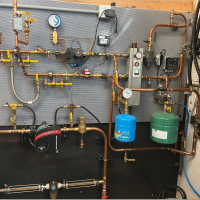
A pic of the piping may help, could be a plugged strainer, mix valve, manifolds not fully opened.
Bob "hot rod" Rohr
trainer for Caleffi NA
Living the hydronic dream0 -
Do you know if the system was engineered? As in, did the installer do calculations of heat loss and heating capacity? The biggest mistake you can make with heated floors is to assume they'll "just work." They often don't.
We can start off by estimating what the heating load is, and then work out ways to get that much heat into the room. To estimate the heating load, we can calculate how much heat is being delivered to the room when the room is 60F and it's 5F out. That's a difference of 55F, to get the room to 70F you need a difference of 65F, which is only 65/55= 1.18, or 18% more. Although that probably underestimates as some flow will come through the interior walls from the heated part of the house.
Two ways of estimating how much heat is being delivered into the room:
- Measure the surface temperature of the floor in enough spots to estimate the average temperature of the floor. The heat delivery, in BTU/hr, will be the temperature difference between the floor and the air in the room, times the square footage of the room, times two.
- Measure the water temperature entering and leaving the floor, and the water flow. The heat delivery, in BTU/hr, should be the temperature difference in the water, times the flow in gallons per minute, times 500.
Those two numbers should roughly agree.
To get the heat output up, you have to increase the temperature of the floor. There are two ways to do that. One is to increase the temperature off the water you're delivering to the floor. The other is to decrease the amount that the temperature drops, which requires increasing the flow.
It's entirely possible that you will turn up the temperature as high as it can go, and turn up the flow as high as it can go, and the floor still won't deliver enough heat. If that's the case we can talk about other ways of adding heat to the room.
0 -
Can you post pics of boiler, circulators, and surrounding piping, wide views too?
What is the supply water temp entering the floor loops? And the return water temp?
0 -
The tube spacing and loop length along with plate type and quantity will mean a whole lot more than the diameter in this case. It sounds like a typical case of insufficient tubing and/or plates, especially with 165* SWT. A system with 800 LF of tubing and 600LF of extruded plates will put out more something like 50 BTU/SF with 165* water while a system with 400LF of tubing and 100LF of beer can plates might only put out 15, so there are a lot of variables on the table here.
0 -
What town are you in?
Tom
Montpelier Vt0


Categories
- All Categories
- 87.8K THE MAIN WALL
- 3.3K A-C, Heat Pumps & Refrigeration
- 59 Biomass
- 430 Carbon Monoxide Awareness
- 133 Chimneys & Flues
- 2.2K Domestic Hot Water
- 6K Gas Heating
- 124 Geothermal
- 170 Indoor-Air Quality
- 3.8K Oil Heating
- 79 Pipe Deterioration
- 1.1K Plumbing
- 6.7K Radiant Heating
- 396 Solar
- 16.1K Strictly Steam
- 3.5K Thermostats and Controls
- 56 Water Quality
- 51 Industry Classes
- 51 Job Opportunities
- 18 Recall Announcements