Original 1969 gas-fired radiant floor heating. Teach me about my system (details included)

Summary
I recently moved into a 1959 house with original in-floor radiant heating. I’d like to share my understanding of the system, and have you experts educate me on how it’s designed to work, whether it is currently working optimally, and if there is anything I need to do. I’m specifically concerned about whether the low temperature return water risks flue gas condensate inside my boiler, which can be a corrosion risk based on my reading.
DetailsMy house is a single story mid-century modern ranch. It has an original, in-slab radiant floor heating system installed during construction in 1959. It covers the entire house, ~2,400 sq feet. The house also has separate, newer heating in the form of 3 daikin mini-split head units (in one wing), and a mitsubishi hyper heat split heat pump (forced air) in the other wing.
The RFH is powered by a Weil-McLain CGa Natural Gas boiler. As far as I can tell, I have a large radiant load with Low water temperature, and no bypass or mixing valve. I also have the make-up line and expansion tank are on the supply side of the boiler, but upstream of the circulator.
The boiler and circulator seem to be running fine, and with my thermal camera I can see the pipes warm up nicely in all sections of the system. (1, 2)
Here’s the original plans for the radiant floor layout
Here’s a layout of the boiler system as far as I can tell. And a video walkthrough
UsageBecause we also have separate heat pumps, and generally like our house a bit colder (especially at night), the system isn’t on very much. I have the thermostat kick the system on at around 4:45am, then shut off around 8am when we leave for the day (or i work from home in my office with a mini split on).
Sometimes we’ll have it kick back on again between 5pm-9pm.
But frankly these 3-4 hour stretches aren’t really enough for the system to reach equilibrium. It’s certainly not heating the whole slab up evenly. This system basically has huge thermal lag. Even after running for 3 hours constantly, the boiler temperature only reaches 115-118F.
Here's a boiler temperature chart.
It seems as if the high volume of cool water flowing through the boiler is sucking the heat out. Once the system shuts off, I see the temperature spike up to 175 or so, before cooling back down (indicates to me that once circulation stops, all the thermal energy in the boiler can all dump into the now-static water in the heat exchanger).
If I understand correctly, the temperature (high temp limit?) setting on the boiler (which i could set to anywhere between 140F and 220 F) is total irrelevant if these temperatures are never reached.
EquipmentBoiler Weil-McLain CGa Series 3 Natural Gas boiler (manual). Simple on/off boiler. It fires up and the circulator turns on when the thermostat calls for heat.
Circulator There’s a single pump on supply side of the boiler, a Taco 007e . There are no zone circulators, just valves.
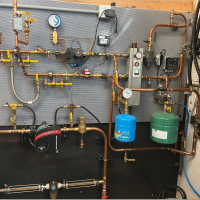
Air separator: Discal Caleffi Air separator Series 551 . I don't really know how these work. Here's an image of mine.
Make-up water: comes through this valve. I haven't experimented to see if it regularly needs more water.
Monitoring: The digital temperature guage on the boiler control board matches the analog temperature guage on the supply line just outside the boiler. The system is at about 16psi.
Chimney / FlueThe boiler exhaust leads to a brick masonry chimney with original clay liner and a few severe offsets (from what I can tell, one offset is almost 90degrees, than another around 45 degrees). I had a chimney company come out and try to run a stainless steel liner, but they couldn’t even get it past the offsets and had to bail on the project. (they tried to drop a 5” liner through the existing clay tiles, they didn’t try removing the tile).
I have a carbon monoxide detector in the basement as well as on the first floor with no alarms.
SystemIf I understand the original plans correctly, the heating pipes are probably 1inch inner diameter black steel pipe. If I do some crude math on the plans, I probably have 2,000 linear feet of pipe, plus extra water in the headers, boiler, returns, etc so may be 100-150 gallons of water in the system.
The zones are controlled by these old valves on a system of two headers (from the plans above, these appear to be on the return side, after the water has left the panels, on the way back to the boiler). I’ve never touched them, but i can tell from my thermal camera water is flowing through them all and getting to all the zones.
I Doubt there’s much insulation under the piping. It looks to me like (from the ground up), my floor is 3” crushed stone, a “Sealtight membrane”, then 4” of concrete with the heating pipes and a steel wire mesh embedded.
Questions- What temperature is my system designed to run at? Does it run really hot water through my floors, but cycle on and off to achieve the temperature set point? Or is it designed to run just warm water through the floors basically constantly to keep temperature? Wouldn’t it need a bypass or mixing valve to do this?
- Is low return water temperature a concern? Some research tells me that return water below 120F risks corrosive condensate in the boiler. My system supply water is barely ever reaching that point, much less the return.
- The system probably rarely reaches equilibrium where the whole slab is warmed up.
- Is my one circulator pump enough to drive the appropriate flow rate through this whole system?
- The make-up line and expansion tank are on the supply side of the boiler, between the boiler and the suction side of the pump. These doesn’t match any of the piping diagrams in the boiler manual. Does this matter?
- Would it be possible (or desirable), for the circulator to keep running for a while after the boiler shuts off ?
- Anything else you can tell me about how these systems were designed to work, or things I should know or fix?
Comments
-
the boiler needs a bypass, ideally thermostatic, to protect it from cold return water. not only will the condensation cause corrosion but it can also cause sooting of the heat exchanger and condensation in your chimney.
The system should be designed to provide maybe 110-120 f water to the loops at max but the mass of the concrete is far more than the output of the boiler so it will absorb most of the heat likely for the better part of a day to several days until the slab reaches temp. The boiler should have a return water temp over about 130-140f to keep it from condensing. As long as the boiler has some sort of bypass to protect it, the water in the slab staying much below the design temp is fine.
The actual design temp of the system would have been part of the system design process, hopefully it is on the drawings somewhere, but you want the floor temp to remain cool enough to walk on comfortably.
Most of the other things would be different if the system were designed today but usually won't affect performance much (other than having no insulation under the slab).
normally in modern systems you would set the slab temp to something that matches the heat loss of the structure and use outdoor reset to vary that setpoint based on the outdoor temp and have it run more or less continuously. because of the mass of the concrete radiant slab systems are generally designed to run constantly at a constant room temp. The mass makes them ill suited to changing temp setpoints of the room or switching them on and off.
0 -
if the vent is a problem you could replace the boiler with a modulating condensing boiler that vents out the side wall with plastic pipe. That is likely less expensive than trying to line a corbled chimney and the mod con can ane likes to have the cold water from the radiant system as return water.
0 -
are you wanting to keep the system in operation?
The boiler needs to have a return temperature valve, for sure
I would pressure test the piping at 30 psi
The flue needs to be addressed.
The life expectancy of the steel pipe is a big unknown
Without underslab or edge insulation it will be expensive to operate
Anything you can do to at least insulate the edge would make a big difference
A condensing boiler coukd reduce ooerating cost some and address the flue if you have a vent path out the sidewall. Or a small plastic liner could fit in the masonry. Centrotherm is one brand
If you keep the boiler or replace it, have a plan b in mind if the loops start leaking, maybe a panel radiator retro fit
A heat liad calc would abswer the question of the temperature requirement for the floors, since you have the tube layout info.
No doubt that warm concrete floors are a great way to heat a slab on grade home
Bob "hot rod" Rohr
trainer for Caleffi NA
Living the hydronic dream0

Categories
- All Categories
- 87.8K THE MAIN WALL
- 3.3K A-C, Heat Pumps & Refrigeration
- 59 Biomass
- 430 Carbon Monoxide Awareness
- 133 Chimneys & Flues
- 2.2K Domestic Hot Water
- 6K Gas Heating
- 124 Geothermal
- 170 Indoor-Air Quality
- 3.8K Oil Heating
- 79 Pipe Deterioration
- 1.1K Plumbing
- 6.7K Radiant Heating
- 396 Solar
- 16.1K Strictly Steam
- 3.5K Thermostats and Controls
- 56 Water Quality
- 51 Industry Classes
- 51 Job Opportunities
- 18 Recall Announcements