Replacing fin tube radiation with cast iron

I have a project; to improve heating in a large dining room. This space originally had four cast iron radiators below tall windows for heat. Some time in the 1990s, the cast iron rads were replaced with 24" sections of fintube radiators inside of restrictive, sheetmetal covers. I have suitable radiators in storage, they may be the correct rads that were removed. The system is two-pipe steam, nominal pressure 2psi. Fintube information taken from closest Slantfin product info.
Help me with the math to show improvement in heating output:
To be removed; 4, 2ft fintube radiators - 1-1/4"CU,48 fins/ft, 1160Btu/hr/ft = 9280 BTU/hr
To install; 4, three-column cast iron, 26"height, 11 sections(@3.75sq'/section) = 9900 BTU/hr
Is my math correct? is the heat gain minimal? The removal of the metal rad covers could be a huge gain.
What are your opinions?
Comments
-
the cast iron has vastly more thermal mass and heats the space far longer in between heating cycles than fin tube
1 -
The fin baseboard has no mass and will stop heating pretty shortly after the boiler stops firing while the cast iron will keep heating for a long time because of it's high mass. That can result a cold dining room if the other radiators in the house are cast iron.
Make sure your contractor understands steam or the work may be for naught. The pipes hacv to be the right size threaded steel and has to be properly sloped.
Bob
Smith G8-3 with EZ Gas @ 90,000 BTU, Single pipe steam
Vaporstat with a 12oz cut-out and 4oz cut-in
3PSI gauge1 -
this work is in a large educational institution. The steam is generated off site and is continuous. The supply valve to the dining room remains open from morning, until after service is finished.
I will be installing the rads in the original locations, piping was laid down circa 1916.0 -
is this actually fintube or is it a convector cabinet? do you have some pictures?
the balance problems are more with the higher mass of the cast iron radiators than the output per se.
1 -
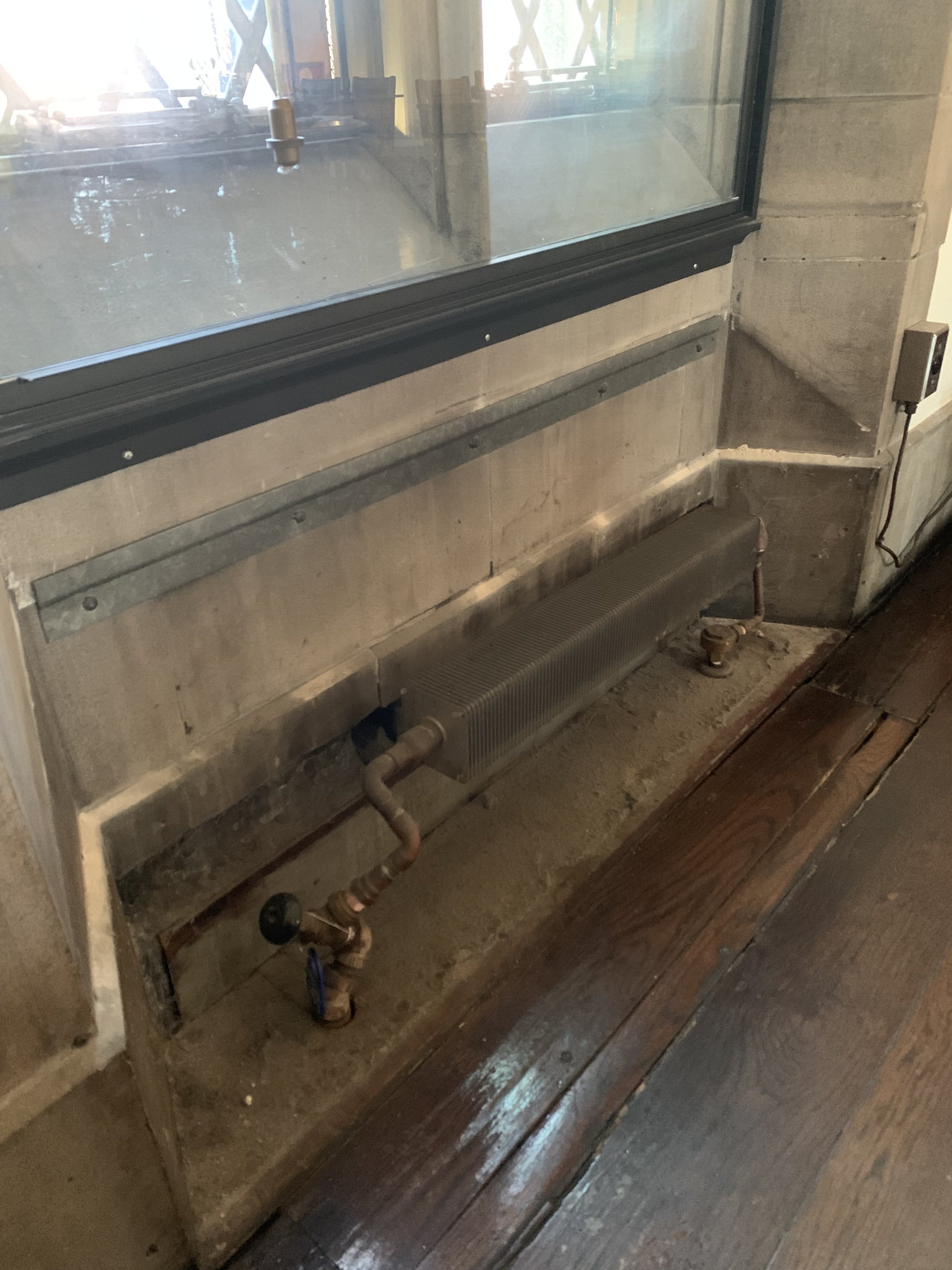
This is a typical installation. The fin tube core and local piping is copper.
I didn’t take a picture of the rad covers, but they left pitifully small open areas to allow convection to warm the room.My primary concern is if the math is correct, I may do a lot of work to clean up the areas, fix the floor, disguise the old holes in the stone and only achieve minimal improvements in heat output. Are these fintube emitters actually more efficient for their size than cast iron? Our steam never cycles off during use.
0 -
that looks like someone that didn't know what they were doing. that fin tube is probably around 500 btu/hr/ft on steam:
if you can figure out the edr of your radiators, steam is about 240 btu/hr per ft^2 of edr so multiply the edr by 240 to get the output.
those look like someone tried to make a convector cabinet but didn't understand how they work. convector elements usually have multiple tubes and more dense fins so the edr of the convector element is a lot more than the fin tube. since it is zoned separately you could also put convector cabinets there.
you should do a heat loss calculation on the space to figure out what you need but you need to include capacity for recovery too.
you could put a trv on each of the emitters to have some control of the output.
1 -
That looks like maybe 1 1/4" fin tube with maybe 3 1/2 x 3 1/2 or 4 x 4 fins. A lot more than 500 btu/foot. Probably more like 1000/foot or more.
 1
1 -
that's why i included the slantfin catalog. the cabinet will increase it some too but it isn't going to do what whoever put it there thought it would.
0 -
Thanks for the thoughts. This is not a proper convector cabinet, the cover is sheet metal with small openings covered with 'Grecian' pattern perforated metal.
This is my reading of the heat capacity of the parts to be considered:
To be removed; 4, 2ft fintube radiators - 1-1/4"CU,48 fins/ft, 1160Btu/hr/ft = 9280 BTU/hr
To install; 4, three-column cast iron, 26"height, 11 sections(@3 .75sq'/section) = 9900 BTU/hr
As this is a commercial dining room, I need more heat in the room; but will cast iron make sitting at the windows, in front of the radiators unbearable?
0


Categories
- All Categories
- 87.8K THE MAIN WALL
- 3.3K A-C, Heat Pumps & Refrigeration
- 59 Biomass
- 430 Carbon Monoxide Awareness
- 133 Chimneys & Flues
- 2.2K Domestic Hot Water
- 6K Gas Heating
- 124 Geothermal
- 170 Indoor-Air Quality
- 3.8K Oil Heating
- 79 Pipe Deterioration
- 1.1K Plumbing
- 6.7K Radiant Heating
- 396 Solar
- 16.1K Strictly Steam
- 3.5K Thermostats and Controls
- 56 Water Quality
- 51 Industry Classes
- 51 Job Opportunities
- 18 Recall Announcements