Installed a main vent and a radiator stopped heating

I posted this photo once before.
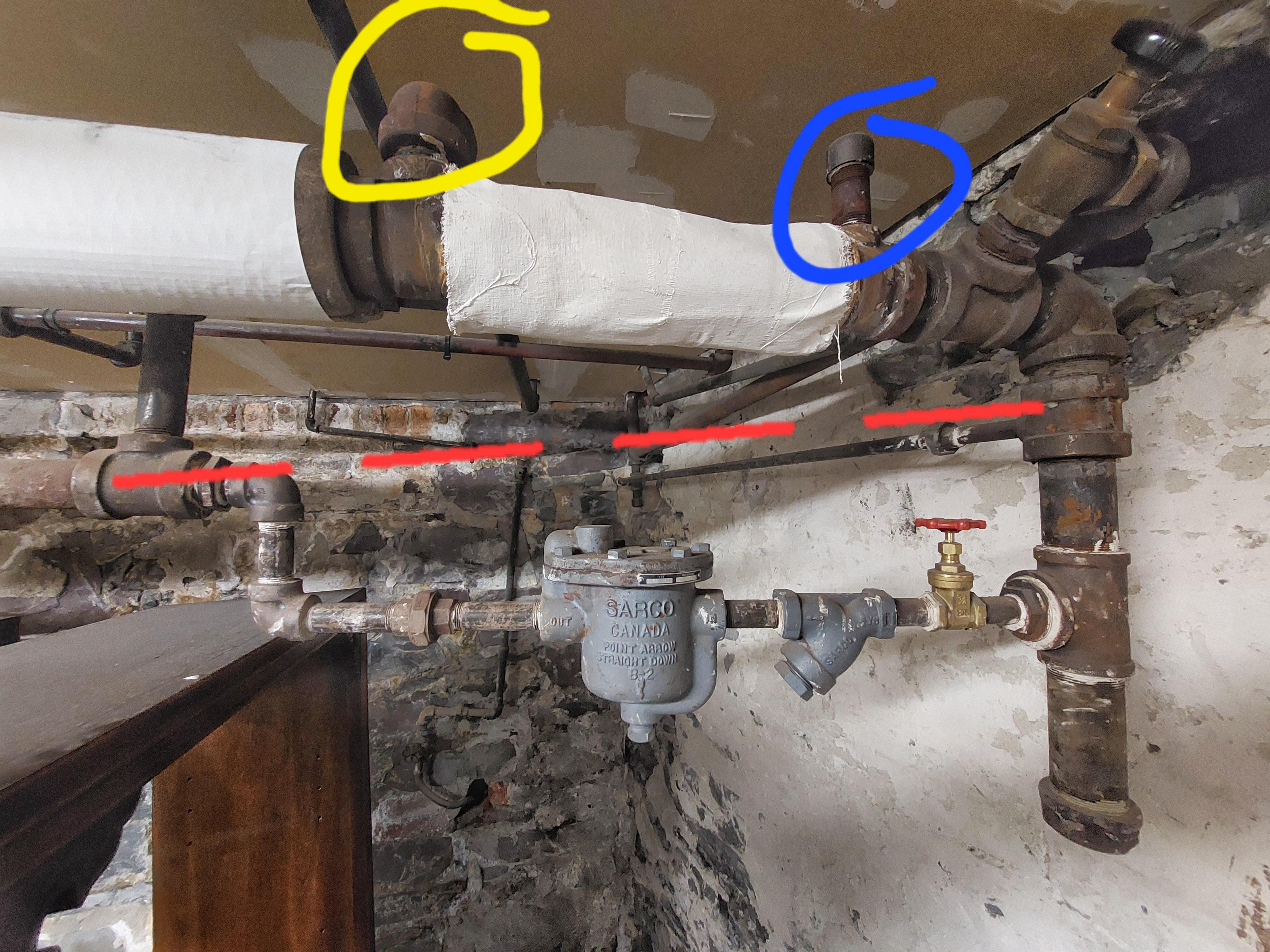
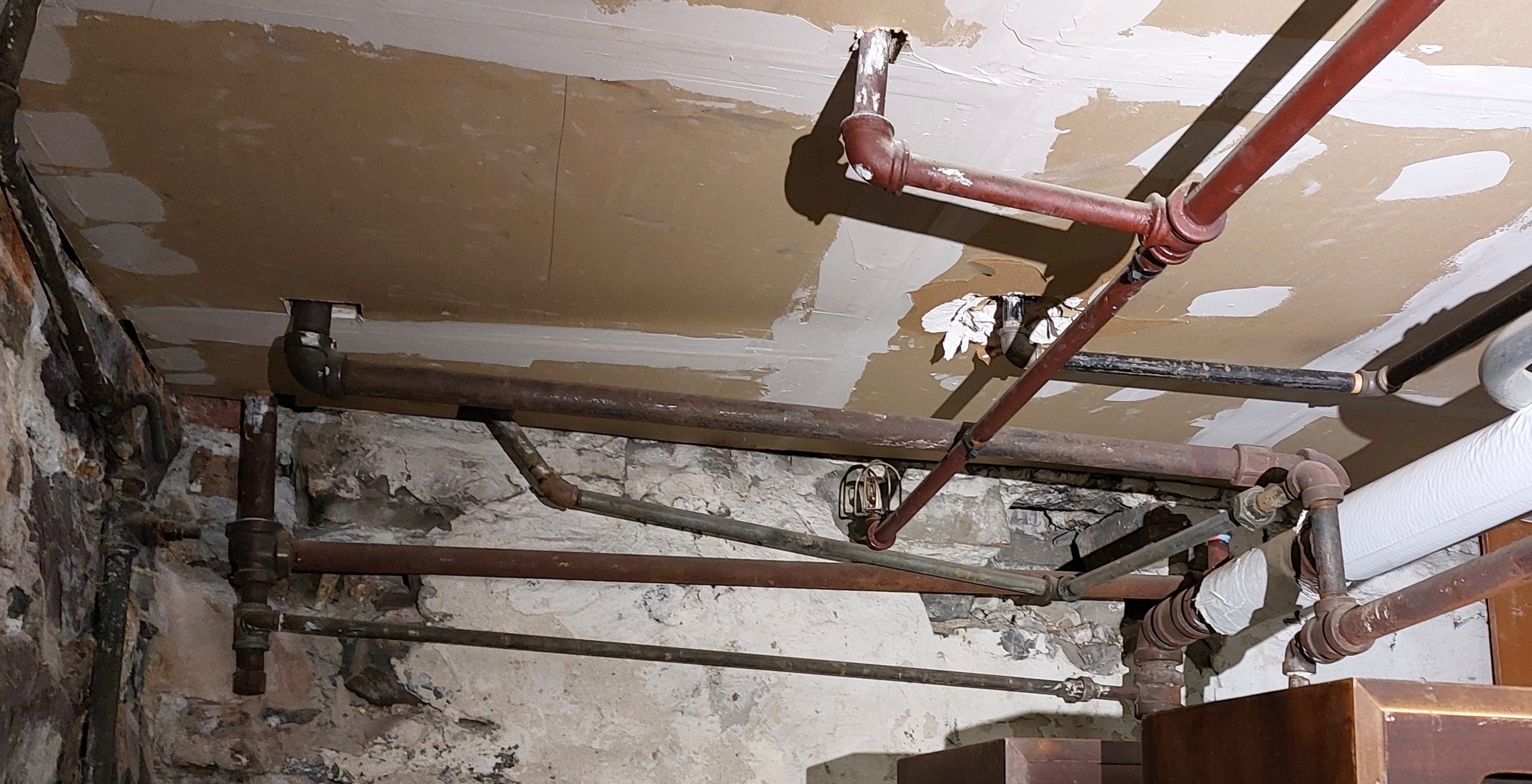
There are a bunch of things wrong here. The return drops significantly at the end and should be angled something like the dotted line. Why the trap assembly starts so far down the drip and needs to come back up, I have no idea whatsoever but a short nipple after the downward 90 into a Tee would have kept everything aligned and pitched properly.
I haven't done this because it works fine for some reason. There's a large radiator 2 floors above here fed by the 1.25" (yellow) that consistently heats reasonably quickly.
Today I took advantage of the 1" stub (blue) and installed a big mouth vent to speed things up for all the branches off this line between the boiler and the location pictured 183 feet away. I waited while the air billowed out of the vent for about 20 minutes then it shut (this is a big improvement). I then go about other things with the boiler running continuously for about 3 hrs only to find the radiator on the second floor (yellow) is stone cold.
How? I can a bunch of reasons why it might not have heated before, I install an air vent and it stops?
Comments
-
-
What vent is on that 2nd floor radiator. Some rebalancing might be expected after adding main venting but after a 3hr run one would expect every radiator to be filled.
0 -
since it is 2 pipe i'd assume none.
1 -
Where does the radiator in question drain to in that picture?
-1 -
The trap works even though dropped lower than the return because you have enough pressure to lift the condensate. Looks to be maybe a 4" lift so around 4" of wc will lift that..
I wouldn't think that adding the big mouth would have any affect on the radiator.
0 -
Maybe the main was building pressure when it had to vent through the trap and now that it can vent without pressure it isn't building pressure to lift out of the trap and condensate is stacking up somewhere? Not sure exactly why that would happen but i'm thinking something along those lines.
0 -
Right on Ed. At the moment we're running on low fire only until a new relay for the burner arrives so I'm unable to move the needle on a 0-3psi guage. Nevertheless, you're right, condensate is moving through that trap. The outlet and first few feet of the return get quite hot. The funny thing is that the radiator heated fine for weeks in this condition and stopped on the very next boiler cycle after installing the vent. I relocated the vent to the second floor between the top of the riser (in yellow) and the radiator and once it closed, the steam stopped moving.
One clue came the on the third cycle with the vent. The air was puffing from the vent accompanied by distant watery gurgling sounds. I suspect water has backed up in the main and the air is having to fight its way past.
It's as though condensate can't get through the trap fast enough to prevent it backing up, either due to insufficient pressure or an obstruction. That whole assembly has likely never been apart and is certainly filled with mud and scale.
I removed the vent which didn't fix anything. I expect there's nothing for it but to rebuild the crossover without the elevation change, correct the pitch of the return and clean everything out.
0 -
This was my first thought too but once the vent closes the pressure build right?
0 -
Bucket traps usually are not the best for low pressure. Also the traps capacity is based on the pressure differential across the trap. No way of knowing how they original calculated that.
Interesting and something most don't know is how to calculate trap capacity for an end of main drip. You measure the length of the main the trap is draining and get the pipe size.
You then figure the WEIGHT of the pipe , valves and fittings in the main. Then estimate the pressure in the main and the pressure in the return. You take the weight of the pipe and figure in the specific weigh of the steel pipe and the temperature rise to figure how much water the trap needs to handle. You also apply a safety factor of 2 to the trap capacity.
 1
1 -
The first Tee after step up from the trap (where the dotted line starts). The pitch coming down from the radiator is fine but it's dropping into a gravity return that is drastically sloped the wrong way for the last 8-10 feet. It must be perpetually full of water. I'm more confused about why it worked before than why it stopped tbh.
0 -
Sure thing.
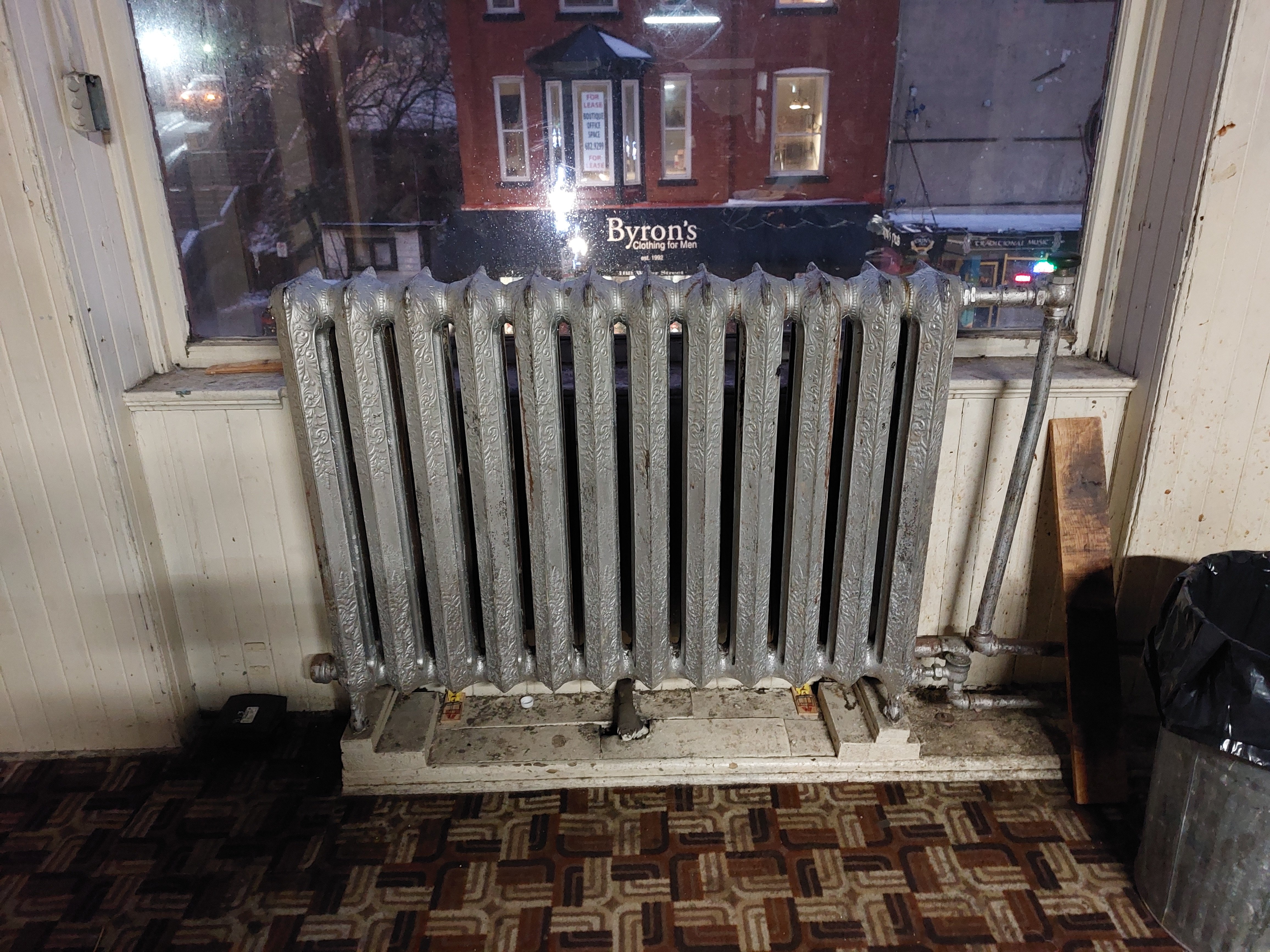
She's a beaut 🫢. The trap has a fresh tunstall capsule but I opened it to check that it was clear and it's fine. Valve is fine too. When I pulled the plug from the vent tapping on the rad, it filled with steam. Problem has gotta be air unable to get out of the return back down in the basement. This is no surprise. The return roughly follows the fall away slope of the main for about the last 10 feet or so and should be starting way higher up that drip. It looks like a tight rope walker's pole. The return from the rad is in the last Tee before 90 down to the trap so it's coming down into a pipe full of water. I'm really more interested in why it worked so easily before the vent than why it stopped.
0 -
first of all, i am just making stuff up here, @EBEBRATT-Ed is the commercial steam guy.
I suppose how much pressure you get depends on how long the boiler runs after the vent closes and how well the boiler is matched to the connected edr. Until the steam works its way in to the emitters it might be more building pressure since there isn't a lot to condense it other than at the front of the progression down the main where the main is still cold.
0 -
is that a lead water service in the background there?
0 -
You have my personal guarantee that nobody did any such calculations here. Not a chance. What are the consequences of getting that sizing wrong?
Also, I genuinely appreciate that information even though I'll likely never size a bucket trap. My little dork brain just loves granular details of how this stuff is engineered.
0 -
if it is way too big, which is what usually happens, the valve will only open a little bit and it will erode the seat from the water squeezing by in that little gap.
0 -
Good eye. I gotta have a closer look. I thought it was rolled copper but it could be lead. This building is from 1893, the year after "the great fire of 1892" razed most of the city - St. John's Newfoundland Canada. It's likely on the stone foundation of whatever building was lost meaning that wall could be 1700s. I really should try and find out.
0 -
rubble foundations were common until around the 1920's or so, probably later in places that had limited coal to make cement and ceramics.
This looks like a wiped joint:
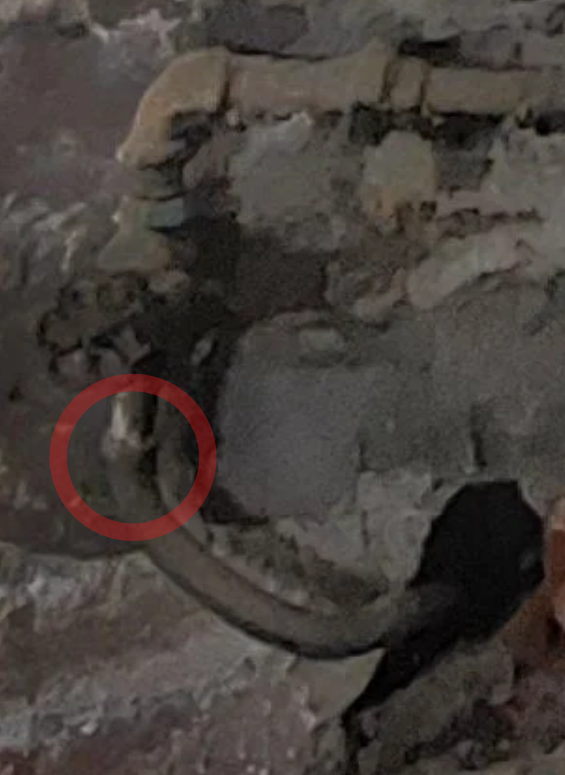
copper also has a more defined look to it and would be hard to bend in to that shape without a hickey or something similar.
0 -
Yes, it's become quite apparent that the low fire nozzle doesn't provide the btus to expel all the air and close all the traps and vents here. That gives me hope that the boiler isn't massively oversized and that once high fire has built that initial pressure we'll be able to drop down to low for the remainder of the cycle. Wouldn't that be nice?
0 -
Maybe vent the return line before it drops in that water trap?
1 -
My house heats just fine on less than 2 inches of water column 0.07 PSIG. I'd get your returns to drain correctly and not rely on pressure to push the condensate along. You may save on fuel too.
National - U.S. Gas Boiler 45+ Years Old
Steam 300 SQ. FT. - EDR 347
One Pipe System0 -
Is it possible you are getting steam intrusion on the return of that radiator? The steam looks like it could enter the return pretty easily
0 -
Yup, I certainly could. It'd be alot less work than resloping the return and rebuilding the drip. That said, I have a feeling that that trap and strainer etc are just jammed full of mud and scale and slowing down condensate flow into the return. I rebuilt an F&T in another area that had a similar rise on the outlet side and I wound up taking everything down to clean it out. You couldn't see through the strainer or the attached nipples and I had to chip the impacted scale out with a screwdriver. If I'm gonna do that, I'd just as soon eliminate the drop at the trap and put everything in a straight line with the proper pitch.
0 -
it looks like iut is difficyult to get the right pitch because there are radiator returns connected to the part of the return that needs to come up so it may be difficult to raise the return and keep pitch in those without reworking them.
that trap could probably be replaced with a radiator trap at the correct level to have pitch.
0 -
Like a failed trap on the rad? It looks gross but it's got a brand new tunstall capsule in it.
0 -
it would be a failed trap on a different radiator, but if the return is full of water you have bigger problems.
0 -
Yeah. I mean, this place is enormous. What you're seeing is the end of a 185ft horizontal main that's 5" for the first 93 feet. But I take your point. Unfortunately there is one place where I've got no choice but to push condensate up 12" (that or demolish an art gallery) so at the very least I need around a half pound to make that function. Gravity is free though, so I'm inclined to let it move as much of my condensate as possible.
0 -
That's so cool. I'll have to take a closer look tomorrow.
0 -
" push condensate up 12" "
I'm surprised this situation exists, two pipe systems are usually designed with very low system pressure in mind and system air venting on the return side. Pushing condensate up 12 inches does not sound like a good design strategy for condensate return or venting air.
National - U.S. Gas Boiler 45+ Years Old
Steam 300 SQ. FT. - EDR 347
One Pipe System0 -
vapor systems are designed that way. it is very common to use steam pressure to lift condensate in ordinary 2 pipe commercial systems.
1 -
I rebuilt all the rad traps and F&Ts in the building this fall with Tunstall kits so I think we're good there. It's not that the whole return is full of water just the last few feet.
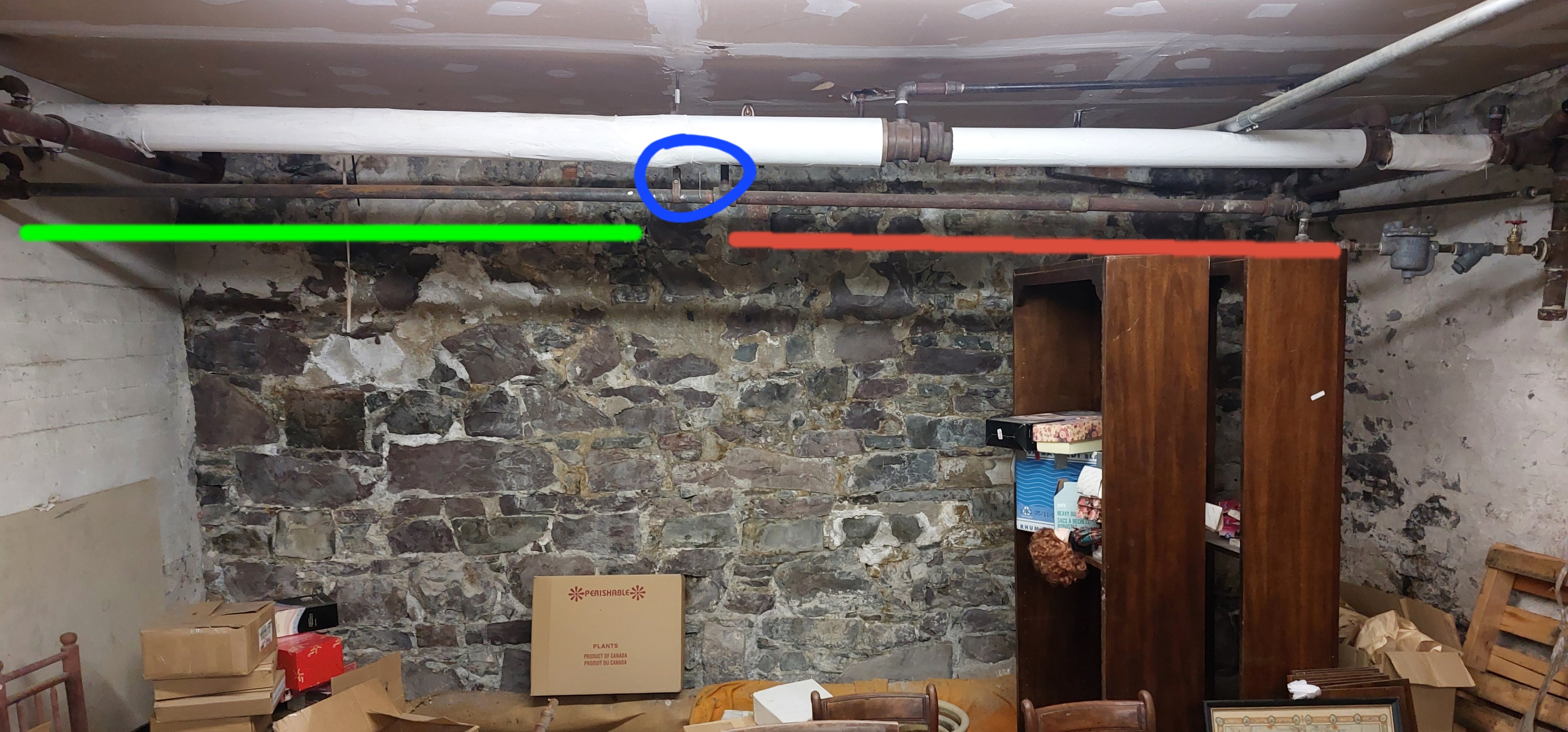
The green section is pitched toward the condensate return tank, from the pipe hanger (blue) the red section bows down to meet the trap for no reason other than 'that's where the Tee in the drip is'. Stupid.
0 -
can you pull that tee down and still have enough pitch on the rest of the line? otherwise pull the end up and shorten something at the end. ideally do ed's math and see if you can use a radiator trap there.
0 -
I'm ok, there are joints that can rotate enough to accommodate the rise.
0 -
I certainly wouldn't have designed it this way either. Sadly, whoever did is long dead so I can't yell at him 🤣.
0 -
not from the radiator trap but from the steam main, assuming that the pipe that connects to the drip at the end of main is the return for that radiator
0 -
Ahhh. Yes. My favorite part of this wacky setup. You see what looks like a radiator valve is an abandoned riser for the 3rd floor. For some reason, instead of inclining toward the ceiling a little and then vertical, it drops away at about 5 degrees so it would fill with water right away. That 1/2" going to the drip is its "return". Check it out.
 0
0


Categories
- All Categories
- 87.8K THE MAIN WALL
- 3.3K A-C, Heat Pumps & Refrigeration
- 59 Biomass
- 430 Carbon Monoxide Awareness
- 133 Chimneys & Flues
- 2.2K Domestic Hot Water
- 6K Gas Heating
- 124 Geothermal
- 170 Indoor-Air Quality
- 3.8K Oil Heating
- 79 Pipe Deterioration
- 1.1K Plumbing
- 6.7K Radiant Heating
- 396 Solar
- 16.1K Strictly Steam
- 3.5K Thermostats and Controls
- 56 Water Quality
- 51 Industry Classes
- 51 Job Opportunities
- 18 Recall Announcements