Ambient or Floor Sensing mode Benefits and Thermostat Recommendations

Currently during construction there are some very basic thermostats using ambient air temperature to control each zone, which works for the purpose of keeping it warm enough. But I wanted to start looking for my permanent thermostats.
So I started going down the rabbit hole of what thermostats I want to get to control this system. There are 5 zones to be controlled and each zone has an in-floor sensor available that was installed when we were building. I want something that is controllable via an app remotely, kind of like the ecobee I am used to at my current house. When I'm on vacation it's nice to be able to check and make sure it's still heating in the dead of winter. It's -10F outside today. One day without a functioning heat system is an emergency.
So with a system like this, what thermostat options would you recommend and also why would I use the in-floor sensor vs ambient with this setup? It seems like if you do in-floor sensing as the control, you need some way to figure out what the floor temp should be based on expected heat loss in the room to get the ambient temperature you want. Which will change based on what it's doing outside. 45F vs -10F, day or night, etc.. Seems like a lot of variables. So isn't controlling the ambient air the more direct way of controlling this system? I'm guessing the main drawback would be overshoot of your ambient setpoint. Or are there smart thermostats that do some math between ambient temp, in-floor temp and outside temp to better control the system? Just trying to figure out what options there are and what will control my ambient temperature more closely to what I'd like it to be.
Comments
-
Hi, JimmyDean. I registered for this site because I wanted to see answers that were posted in response to your excellently described scenario. Unfortunately, there are no responses!
My situation is very similar to yours. Can you share any findings that may be helpful?
Specifically, I am installing a 3-zone radiant system under the sub-floor of my main living floor which has a full basement underneath. Later, I'll be installing three more zones for the basement as I finish it out with a couple of Air BnB's. I want thermostats that will read ambient and probe temperatures. Did you find anything that you can recommend? Of course, I'll need a zone controller to go along with that. Hopefully made by the same manufacturer.
Thanks for any help you may be able to provide!
0 -
I like floor sensors in bathrooms, then you can maintain a warm floor even when AC is on
No harm in having sensor wells in multiple areas, but air temperature control is most common
Pex tube fir sensor conduit to the stat location
Bob "hot rod" Rohr
trainer for Caleffi NA
Living the hydronic dream0 -
With any heating system you want to match the amount of heat supplied to the heat loss of the space. If you have a heating system that responds quickly, you can just turn it on when the temperature gets half a degree or so below the thermostat set point, and turn it off when the temperature gets half a degree warmer than the set point.
With a heated floor, the amount of heat produced is determined by the temperature difference between the room and the floor. What you run into with concrete floors is that the floor holds a lot of heat relative to the heating load, so even if you stop providing heat to the floor it is still providing heat to the room. Similarly, if you need to increase the amount of heat going into the room you need to warm the slab up first, if it's starting off cold that can take a while.
To avoid overshooting, what you want to do is anticipate what the heating load is going to be. So rather than looking at the current room temperature, you look at the outdoor temperature and try to direct the floor temperature toward a point where it meets the heating load you anticipate at that outdoor temperature. There are two ways to control the floor temperature, which can be combined. One is to put a temperature sensor in the floor and turn the heat on and off to maintain the temperature you want. The other is to modulate the temperature of the hot water being delivered to the floor depending on the outside temperature, getting hotter as it gets colder outside.
How well this strategy works depends on how well the heating load tracks the outdoor temperature. If you have a house with large south-facing windows, the heating load is going to be determined quite a bit by whether the sun is shining. If you have a leaky house how windy it is outside will play a big role in the heating load.
An alternative strategy is to size the floor to provide only part of the heating load have another heating device which has fast responsiveness to provide the rest of the load. That device can be connected to a simple on-off thermostat measuring air temperature. If you also have air conditioning, it's often simplest to use the air conditioning ductwork to deliver this supplemental heating.
0 -
You want floor sensing generally for two resason. One to maintain a min temperature (ie freeze protection or comfort as per @hot_rod) or max temperature limit to protect wood flooring. You still need air temperature for main control, floor temp sensing is only for limit control.
I've used Honeywell TH115-AF series that will do air and floor heat sensing and control.
Also watch where you put the floor sensor, you want it to pick up slab temperature not tubing temperature. For slabs this mean putting the sensor near the surface and away from tubes. +1 on the sensor inside a length of pex, protects the sensor and makes replacement a breeze.
0 -
If you have rooms with high solar gains, this was very common with homes in Colorado with large south facing glass, then floor sensors may be a nice option for another level of control.
I've been in those large glass walled homes with AC running in 1/2 of the house, heat in the north side!
This was my go to basic air/slab stat, it is sold under various radiant brands. No programming or setback schedules to tempt homeowners. Just let radiant systems run at a comfortable temperature.
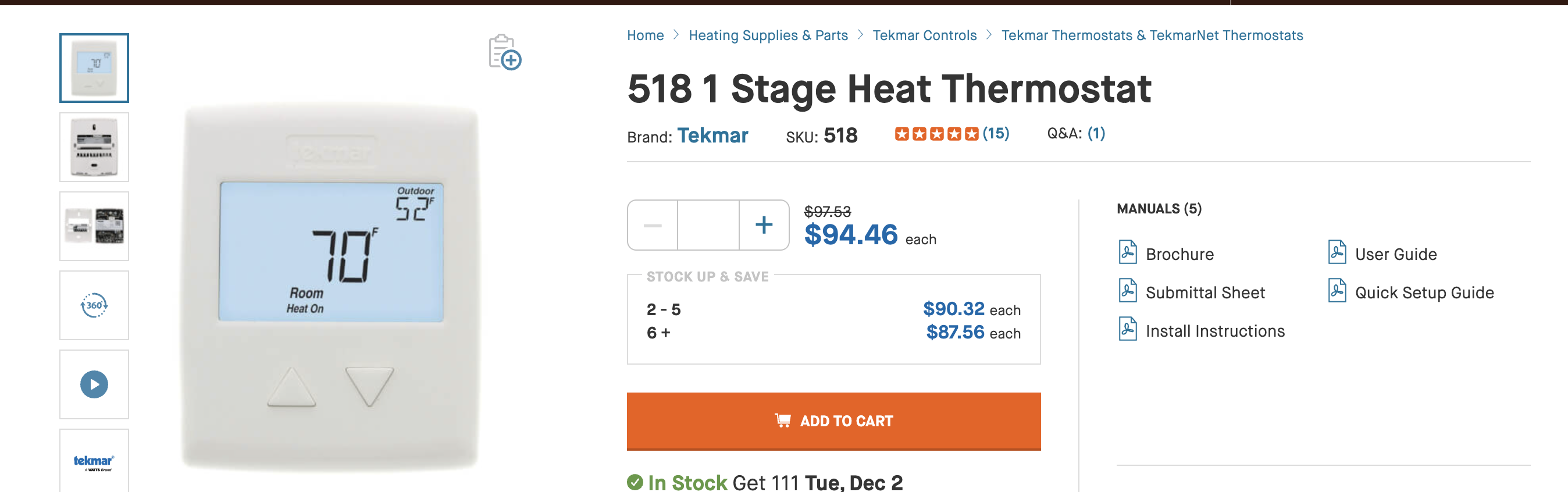
Another option is all the stats are mounted by the boiler with just sensors in the rooms. If you don't want to see wall stats throughout the home.
Ideally you get the system adjusted to a comfort level where you don't need to look at the temperature on the t-stat to know you are comfortable :)
Bob "hot rod" Rohr
trainer for Caleffi NA
Living the hydronic dream0 -
A video on floor sensor sensor options.
Bob "hot rod" Rohr
trainer for Caleffi NA
Living the hydronic dream0



Categories
- All Categories
- 87.8K THE MAIN WALL
- 3.3K A-C, Heat Pumps & Refrigeration
- 59 Biomass
- 430 Carbon Monoxide Awareness
- 133 Chimneys & Flues
- 2.2K Domestic Hot Water
- 6K Gas Heating
- 124 Geothermal
- 170 Indoor-Air Quality
- 3.8K Oil Heating
- 79 Pipe Deterioration
- 1.1K Plumbing
- 6.7K Radiant Heating
- 396 Solar
- 16.1K Strictly Steam
- 3.5K Thermostats and Controls
- 56 Water Quality
- 51 Industry Classes
- 51 Job Opportunities
- 18 Recall Announcements